
I have Groin pain, what can I do?
Groin pain is a recurrent condition in the sporting population, whether it is professional or amatorial. At Movement Based Therapy we have encountered different types of patients suffering from groin issues, and since the symptoms can be similar but the causes can be different and vary, we wanted to bring a little clarity to the confusion around groin pain.
This blog is meant to shine a light on groin complaints, explaining the causes, the different structures that can be involved and presenting the approach that we have at MBT to help you treat it!
With groin pain we clinically refer to pain that is perceived in the anterior inner portion of the upper thigh, close to the pubic region. In this area musculoskeletal structures, internal organs and urogenital structures come together. Problems with the hip adductors, hip flexors, abdominals muscles, pubic symphysis and the inguinal region can reproduce pain in acute or chronic circumstances, of traumatic or overuse nature.
Epidemiology – Groin pain is mainly represented in the sporting categories, with a higher incidence in sports that involve running, cutting maneuvers and kicking, found for instance in soccer and hockey.
The most common injuries are the ones that are adductor related. In professional ice hockey and soccer players throughout the world, approximately 10% to 11% of all injuries are groin strains. (Tyler et al., 2010)
In sex-comparable sports, men reported a higher risk of injury compared to women, with the most common injury mechanism being noncontact and overuse/gradual. In the latter category, men had a greater proportion of injuries due to player contact than women, who presented a greater rate of injury due to overuse/gradual. (Kerbel et al., 2018)
Acute or chronic groin pain
The major distinction between acute and chronic groin pain is the duration of the symptoms, while they do not differ in mechanism of onset, and they can both start suddenly or gradually.
Acute groin injuries usually involve one or more musculotendinous structures and happen during explosive actions or movements when the muscle is stretched during a forceful contraction (i.e. kicking, sudden change of direction, etc.).
The classification of chronic groin pain has been made more clear by the Doha agreement of 2015 and differentiates into the three following major categories:
1. Defined clinical entities for groin pain :
- Adductor-related groin pain
- Iliopsoas-related groin pain
- Inguinal-related groin pain
- Pubic-related groin pain
2. Hip–related groin pain
3. The third category is referred to different musculoskeletal causes being obturator nerve entrapment, stress fracture and referred pain the most common. Other causes referred to the internal organ structures found in the groin region can be hinted during the screening and examination, and will be referred to the GP for a more accurate identification and tailored treatment. (Weir et al., 2015)
History and pain pattern in patiënts with Groin pain
Pain is usually perceived in the medial upper thigh, close to the insertion of the adductors group, or can be more central in the upper thigh, under the inguinal ligament and around the hip joint/iliopsoas region.
In most cases it starts as a unilateral and localized pain that can later spread to more regions and become bilateral. It is aggravated by activity, initially affecting the final phase of activity and/or after the activity, reproducing following pain and stiffness. The latter feelings are lessened by activities and warm-up routines. As the groin pain worsens, it is present upon initiation of exercise.
Activities such as running, twisting, turning and kicking are the most eliciting. (Brukner et al., 2017)
Targeted assessment
It is essential to understand the cause of the pain with a proper assessment to plan an appropriate and targeted treatment based on the differential diagnosis of groin pain.
In the case of an acute injury we advise you to reach out for an assessment in case you had a recent trauma during play or activity, the symptoms are aggravating and are impeding in your daily activities. On the other hand, if you have been dealing with long standing groin pain lasting weeks or even months, which can be following a past trauma, or a lingering issue that does recur when you do activities, we can help you understand the root of your chronic condition.
If you are starting to experience some groin pain, try the exercises shown in the videos below. These exercises are targeting complaints coming from the hip flexors and hip adductors. Give it a go and see if they help to ease the pain!
Otherwise you can contact us to schedule an intake here or book it directly online, and we will be happy to help you!
At Movement Based Therapy we can conduct an insightful screening and patient history of the pain, to grasp a better understanding of the pain and setting the basis for the following physical assessment, so the examination is targeted and specific to each case, aimed to find the source of the complaints upon which to establish the treatment plan to safely return you to daily life and sport.
The first focus would be to identify the area of pain and reconduct it to the groin area.
Palpation for tenderness of structure and pain reproduction is the first step into better locating the painful region to differentiate the following tests.
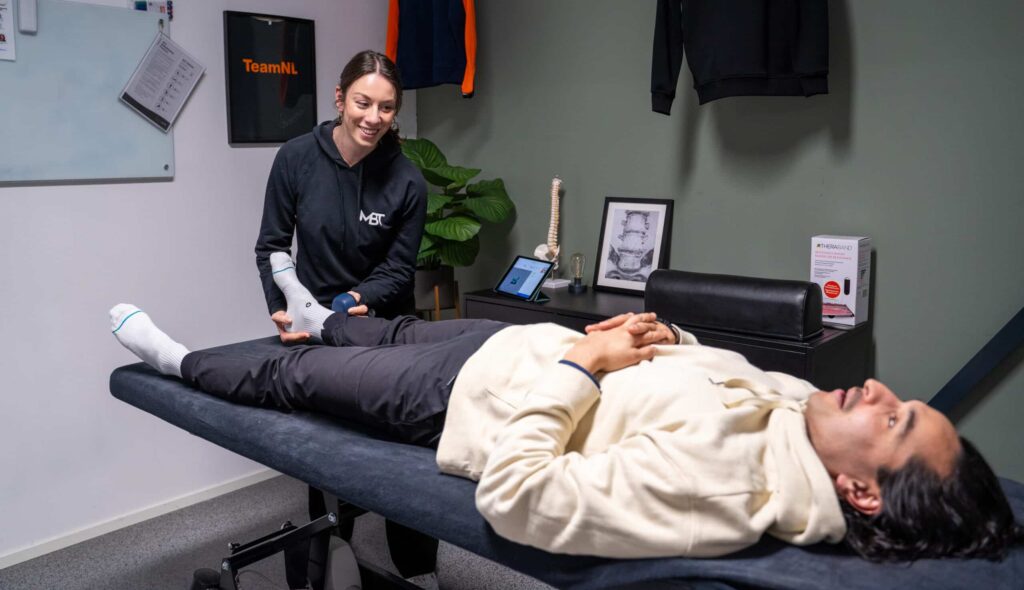
More specifically, an assessment of active and passive range of motion and strength testing of the involved structures. At MBT we make use of a Hand Held Dynamometer to measure strength output and have an objective measurement that we can rely on to do a reassessment and measure progress.
Depending on the case we can make use of force plates to better define the profile of the athlete and target possible disbalances in different conditions, from power output to force distribution, making sure to adapt the testings to the activities specific to the patient.
To dive in deeper into the cause of the pain and finalize the assessment, specific testing and a functional assessment of provoking activities will be performed.
How to treat people who are suffering from Groin pain?
At Movement Based Therapy we prioritize a holistic approach to rehabilitation.
It is important for us to set the focus on you and your goals, and taking them into account to define the rehabilitation trajectory that best suits your needs.
In the case of groin pain, understanding the structures that are involved in the pain reproduction is important and indicative, and will define the typology of interventions.
The main intervention focus is to reduce the pain and restore optimal functionality, through an initial phase of deloading and strengthening which will later be progressed to more dynamic routines to return to your sport.
At MBT we believe in educating you with regards to your complaints and give you the tools to improve your symptoms through active exercise therapy while setting a treatment plan that is taking into account your schedule and your goals.
References
Brukner, P., Clarsen, B., Cook, J., Cools, A., Crossley, K., Hutchinson, M., et al. (2017). Clinical sports medicine. Volume 1 Injuries. McGraw-Hill Education, (Australia), (629-657).
Kerbel, Y.E., Smith,C.M., Prodromo, J.P., Nzeogu, M.I., Mulcahey, M.K. (2018). Epidemiology of Hip and Groin Injuries in Collegiate Athletes in the United States. Orthopaedic Journal of Sports Medicine, 6(5). doi:10.1177/2325967118771676
Tyler, T. F., Silvers, H. J., Gerhardt, M. B., & Nicholas, S. J. (2010). Groin injuries in sports medicine. Sports health, 2(3), 231–236. https://doi.org/10.1177/1941738110366820
Weir, A., Brukner, P., Delahunt, E., Ekstrand, J., Griffin, D., Khan, K. M., et al,.(2015). Doha agreement meeting on terminology and definitions in groin pain in athletes. British Journal of Sports Medicine, 49(12), 768–774.doi:10.1136/bjsports-2015-094869

